

The Premium Gap: Why Your Visual Identity Is Sabotaging Your Price Point

Defining the Premium Gap in B2B SaaS
The Premium Gap isn’t about taste. It’s about misalignment. It appears when a B2B company sells enterprise‑grade technology but presents itself like an SMB.
You ask for a high ACV, yet your website, sales deck, and collateral look like a lightweight startup.
For a rational buyer, that mismatch creates cognitive dissonance: the promised value and the price are not supported by the visual signals.
In complex B2B sales, price perception forms long before the demo. Early touchpoints - website, LinkedIn presence, product marketing, slides - act as your storefront.
The Premium Gap occurs when your visual identity fails to signal the quality and reliability of your technology, causing friction in sales and price resistance.
Instead of discussing outcomes, your team explains why the price is “so high for a company that looks like this.”
Sales‑Led SaaS: When the Brand Undermines the Rep
In a sales‑led motion, the Premium Gap appears within the conversation. Your reps ask for $50k–$100k+.
The product and roadmap can justify it, but the visual environment - website, deck, product UI - quietly works against them.
Buyers don’t say it, but they think: “This feels like a company that should be cheaper.”
That thought triggers:
- more objections
- earlier discount pressure
- longer procurement cycles
- more stakeholders pulled in “just to be safe”
Reps end up defending price instead of discussing outcomes. This is not a sales skill issue, it’s a signal problem.
When visual signals lack institutional weight, the buyer adds a risk premium, and tries to recover it through negotiation.
Product‑Led SaaS: When the Gap Kills Momentum Before Pricing
In product‑led motion, the Premium Gap appears before sales is involved. Buyers self‑educate, explore the site, try the product, and quietly form expectations.
If the visual anchor is low, the price feels high, no matter how strong the product experience is.
If you are not delivering a premium digital experience at the brand level, buyers will hesitate to pay a premium price.
That leads to:
- hesitation on the pricing page
- stalled upgrades
- “we’ll think about it” exits
- fewer enterprise handoffs to sales
The product may perform well, but perceived risk stays unresolved. Without trust, buyers delay commitment - especially at higher tiers.
Design reduces perceived risk and anchors price expectations.
This is why visual identity plays a direct role in pricing power, not just brand perception.
Most design work optimizes for appearance - a cleaner interface, a fresher brand, a more modern look. Helpful, but it doesn’t close the Premium Gap.
Eloqwnt treats design as infrastructure for price protection: aligning visual signals with enterprise product reality, reducing perceived vendor risk, supporting sales conversations instead of complicating them, and anchoring value before negotiations begin.
This is not about “looking premium.” It’s about making sure that when your team asks for premium pricing, nothing in your brand quietly contradicts them, especially when you rely on differentiation in a saturated market to justify that price.
The Psychology of the Price Anchor
In SaaS, price never exists in isolation. Buyers constantly compare it to internal build options, competing solutions, and their mental model of “what companies like this usually cost.” But before any number is shown, a different anchor is already in place: the visual anchor.
Your initial presentation sets a subconscious impression of your scale, reliability, and competence. It is a silent signal that happens in seconds.
An early-stage-looking landing page, inconsistent typography, and a cobbled‑together sales deck push that anchor down.
Against this low baseline, a six‑figure annual contract feels inflated, even if the product objectively delivers that value.
The "Risk Premium" vs. Institutional Trust
Research on perceived value shows that people infer trustworthiness from surface attributes: layout clarity, design cohesion, and visual fidelity.
When those cues are weak, the buyer’s brain silently adds a “risk premium” to your price. This internal friction makes every dollar harder to justify.
Conversely, an institutional, high‑fidelity brand presence sets a high anchor. It signals that your price lives in the same category as established, defensible solutions.
Anchoring High-ACV Conversations
In high-ACV scenarios, this visual signaling matters enormously. It is the foundation of your pricing power.
Long before a CFO reviews your ROI model, your visual identity has either reduced or amplified the tension around your price.
Price anchoring starts not in the proposal, but in the perception created by your visual infrastructure.
It is the system of touchpoints that quietly tells the buyer what “type” of company you are, and what price you are allowed to command.
Engineering the Halo Effect
Closing the Premium Gap is not about “refreshing the look.”
It is about building a visual infrastructure that systematically creates a Halo Effect around your product - a positive bias where external presentation elevates expectations about internal quality.
Consistency as Stability
Fragmented collateral across websites, decks, and PDFs signals operational instability and disjointed processes.
If communication lacks coherence, buyers doubt your ability to manage complex implementations or long-term support.
Conversely, a unified visual system - consistent in logo, typography, and diagrams - signals stability and institutional rigor.
This intentional design language functions as Trust Architecture, lowering perceived risk for enterprise buyers before they ever review your technical architecture.
UX as Competence
Buyers also project product quality from the UX they experience in your external touchpoints.
A seamless UX, even in marketing and sales surfaces, is a live demonstration of your technical competence.
Clear hierarchy, intuitive flows, and predictable patterns reduce fears about deployment risk and support burden.
Well‑engineered UX is part of your risk mitigation infrastructure, not just an aesthetic bonus.
Visuals as Valuation
The Halo Effect means buyers generalize from one strong signal to a whole set of judgments.
High‑fidelity, institutional‑grade visuals make it natural to assume your product is equally considered, robust, and defensible.
Eloqwnt’s approach is built around this reality: not chasing trends, but constructing a premium visual infrastructure that deliberately creates a Halo Effect and reduces operational friction.
This methodology helps to visually anchor a high price even before the customer sees the product itself.
The outcome is simple: your team spends less time proving you are serious enough to charge what you charge - and more time closing the right deals.
The ROI of Optics
Visual identity is often misclassified as a marketing expense.
In high‑ACV SaaS, it functions more accurately as a margin protection asset: a set of systems and strategic brand identity that support your ability to hold price, compress the sales cycle, and minimize discounting.
Consider the difference between generic, low-fidelity branding and a premium, institutional‑grade brand infrastructure:
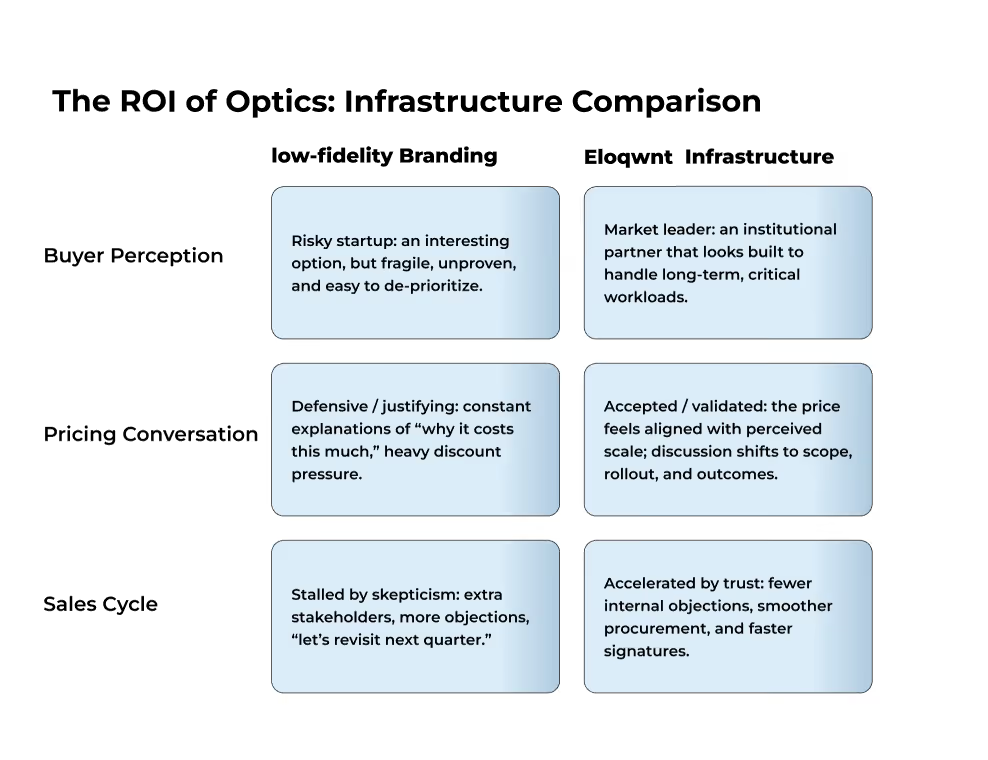
Strong optics multiply product value and sales capability rather than replacing them.
They support higher ACV targets and increase sales velocity by removing trust barriers before procurement begins.
By functioning as a Visual Anchor, premium design reduces the need for discounting and serves as a measurable driver of ROI.
Common Objections
“Can't the product speak for itself?”
Only if buyers trust you enough to get to the product. In most funnels, a significant percentage of opportunities is lost before any hands‑on experience: at the homepage, on the pricing page, or during internal forwards of your deck.
If your visual identity triggers low trust, key stakeholders will quietly opt out or deprioritize you without ever testing the platform.
Your product cannot speak for itself if the room goes silent before it enters the conversation.
Visual infrastructure keeps the door open long enough for your capabilities, references, and results to matter.
“Is this just for enterprise?”
Enterprise deals make the Premium Gap painfully visible, but the logic applies anywhere you are defending non‑commodity pricing.
If you are consistently being pushed into discounts at mid‑market levels, the issue may not be only in your pricing model — it may be that your storefront does not match the story you are trying to tell.
Any SaaS company that wants to protect margins, avoid a race to the bottom, and compete on value rather than on sheer price benefits from a more institutional, premium identity.
For growing teams, building a defensible brand early can prevent costly re‑pricing and repositioning later.
“How do we measure this?”
You can and should treat visual infrastructure as a measurable asset. Key indicators include:
- Conversion rate on pricing and “Request a demo” pages before and after visual upgrades.
- Percentage of closed‑won deals at full list price versus discounted.
- Average sales cycle length in days from first meaningful touch to signature.
- Frequency of discount requests or “can you come in lower?” as a percentage of qualified opportunities.
Over time, a stronger, more defensible brand should correlate with higher ACV resilience, fewer concessions, and smoother progression through late‑stage approvals.
The optics do not close deals alone, but they remove frictions that make every deal more expensive to win.
Final Thought
Don’t let your brand undermine your engineering.
If your visual identity still looks like an early MVP, you are paying a hidden tax on doubt that makes it impossible to protect your premium ACV.
This tax manifests itself in lower ACV, lengthy negotiations, deep discounts, and lost deals that never get far enough to assess your actual capabilities.
Your brand should act as an institutional infrastructure that makes your pricing feel natural, not ambitious.
It must support your sales pitch, not subtly sabotage it.
Audit your Premium Gap with Eloqwnt. Transform your visual identity from a marketing expense into a defensible asset that protects your price and accelerates your sales cycle.




The right partner at the right moment changes everything.
Tell us about your next stage.


