

The Premium Gap: Why Your Low-Fidelity Brand is Leaking Margin

Design sits at the crossroads of marketing fluff and revenue infrastructure, so teams overlook it until the Premium Gap is impossible to ignore.
This shift usually demands a targeted strategic modernization of visual assets to match the company’s actual scale.
Without a systemic approach, most firms try to escape the Sea of Sameness by shipping more features instead of strengthening brand signals.
The B2B companies that win treat brand infrastructure as an ongoing system, not a one-time cosmetic refresh.
In high-stakes B2B SaaS, visual identity becomes a diagnostic signal of operational maturity - closing the Premium Gap, defending Margins, and anchoring conversations on value rather than price.
The Economics of Perception
B2B buyers use visual heuristics for rapid risk assessment.
Clarity, cohesion, and high-fidelity design serve as "trust proxies" that influence the Willingness to Pay (WTP).
Research from ProfitWell shows that design quality correlates directly with price elasticity.
High-fidelity visuals create a Halo Effect, where the perceived value of the software increases simply due to its presentation.
Buyers don’t anchor on price in a vacuum - they anchor on how you look.
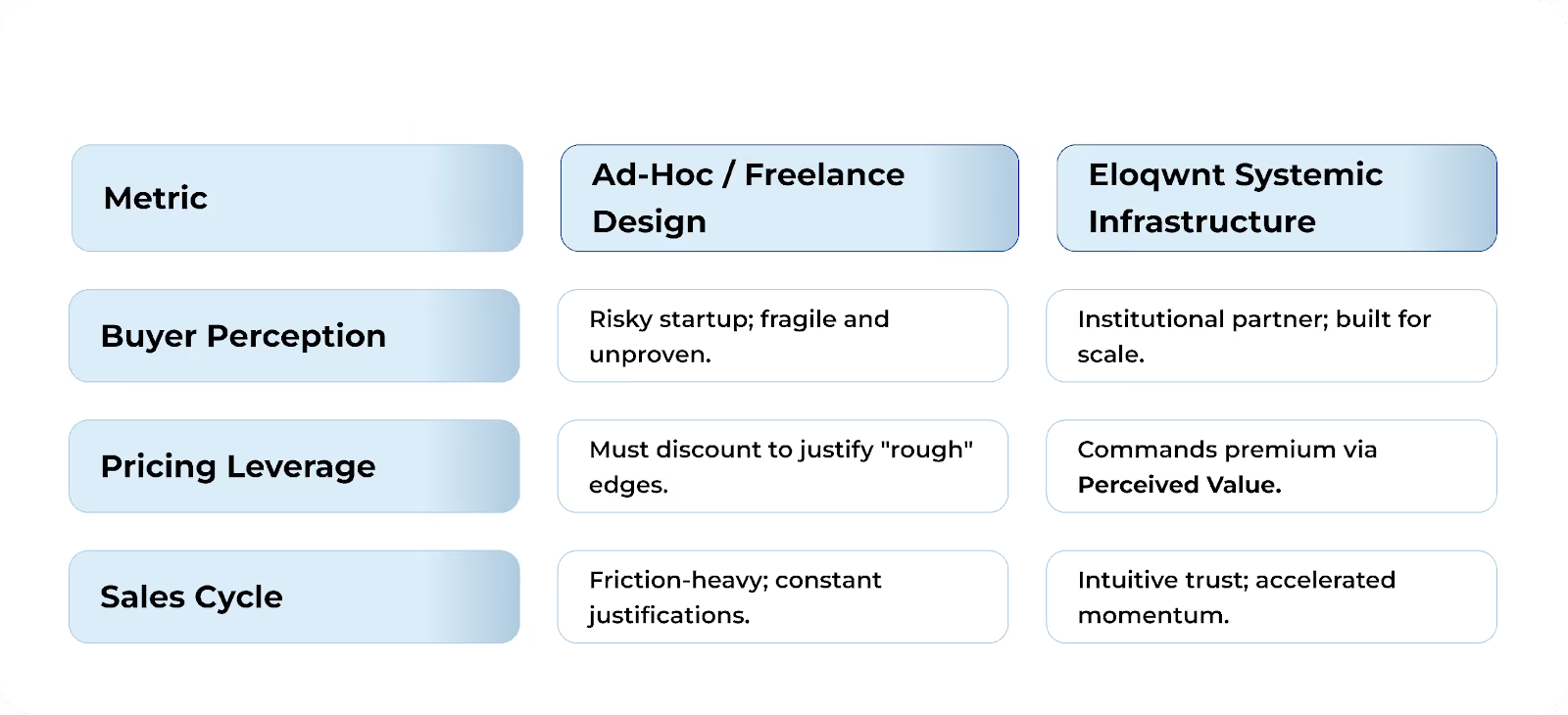
If your brand signals the logic of a $20/month tool, you cannot credibly defend a $20,000 annual contract.
The visual baseline becomes a Price Anchor that sets the ceiling for negotiations before a single number is shown.
Consistency across deck, site, and product lifts that anchor from "risky beta" to market leader, providing the Risk Mitigation buyers pay a premium for.
Operationalizing Trust (The System)
Design sits where marketing fluff should turn into revenue infrastructure - but many teams never make that shift.
The B2B companies that win treat brand infrastructure as a tunable system, not a static wrapper.
In that model, brand authority becomes a compressed, step‑by‑step signal of Perceived Value that quietly defends your Margin.
The Eloqwnt Brand Toolkit fixes the weakest link in this system by giving sales teams modular, approved assets they can assemble instead of invent.
1. Signal Density & The Halo Effect High-fidelity design acts as a diagnostic signal for engineering excellence.
Buyers apply a Halo Effect, assuming that precision in pixels reflects equal rigor in codebase and security.
2. Risk Mitigation through Consistency Inconsistency signals operational chaos, creating friction during procurement.
Risk Mitigation is proven when the brand remains cohesive from Sales Deck to Product UI.
This consistency signals organizational maturity, identifying you as an institutional-ready leader.
3. The "Velvet Rope" UI Modern buyers reject the cumbersome, "utilitarian" experience of legacy software.
Using "Consumer-Grade" aesthetics creates a Velvet Rope UI that feels intuitive and premium.
This distancing from legacy competitors justifies price and turns your solution into a competitive advantage.
The Cost of "Good Enough" Design
Nobody wants to be stuck in a race to the bottom where the only way to win is by being the cheapest option in the room.

A high-fidelity brand grants you the right to opt out of price wars, reducing price elasticity and allowing you to defend your margin even when competitors start to discount.
Investor FAQ: Design & Valuation
Q: How do we actually measure ROI on brand in B2B SaaS after rebranding?
A: We view brand as a revenue variable, not a vanity metric.
The key signal is the before-and-after delta for three numbers: ACV, discount rate, and sales velocity.
If a highly accurate, consistent design ratio works, you’ll see fewer discount requests, higher average contract sizes, and shorter procurement cycles.
Over the long term, the same change translates into improved CAC and stronger LTV/margin retention because you’re no longer “buying” customers with discounts just to sign contracts.
Q: Can design actually reduce Customer Acquisition Cost (CAC)?
A: Yes. High-fidelity assets convert prospects faster, lowering the "trust tax" and total resources spent on closing each lead.
Q: Why is "Perceived Value" more important than features in early sales?
A: Features are analyzed by the mind, but value is felt by the gut.
If the High-fidelity presentation matches the contract size, the price feels natural rather than ambitious.
Q: What is the mechanism for reducing Customer Acquisition Cost via Design?
A: Design shortens the price justification phase.
This reduces executive time spent per deal and increases demo-to-contract conversion, directly lowering your CAC.
Final thoughts
Design debt is financial debt.
Every day your brand fails to reflect the quality of your engineering, you are leaving money on the table and leaking Margin.
Your product might be world-class.
Your team might be elite.
But if your visual identity signals “average,” your sales team is forced to discount before the conversation even starts.
According to McKinsey, companies in the top quartile of the Design Index achieved 32% higher revenue growth than their peers.
Stop letting your visual identity undermine your sales team.
Audit your visual infrastructure today to close the Premium Gap.
Contact Eloqwnt to transform your brand into a defensible financial asset.
Design should compound value, not quietly drain it.




The right partner at the right moment changes everything.
Tell us about your next stage.


